
SAMPLE LEARNING ENGAGEMENTS
STRAND:
Partitioning Sample Page
Click Here to Register
Developed by Kelvin Sparks, Andrea Uhl and Gareth Rose (2020/21)
PHASE
5

Relevant Reading:
Partitioning Introduction
How to use the Learning Engagements

Time Allocated
6 Weeks (30 blocks of 45min)

Answer Key
Partitioning Phase 5 Answer Key
Conceptual Understandings Covered in this Unit
U1
In a fraction, the denominator represents the equal number of parts in the whole and the numerator represents the number of those parts involved in the problem.
Start Understanding 1
U2
The greater the number of equal parts, the smaller each part becomes.
Start Understanding 2
U3
To add or subtract fractions with the same denominator, people add or subtract the numerators, but the denominator (the total number of parts) stays the same.
Start Understanding 3
U4
Fractions can describe quantities greater than one whole and can be represented as improper fractions or mixed numbers.
Start Understanding 4
U5
An equivalent fraction describes the same quantity using equal parts of a different size.
Start Understanding 5
U6
Mathematicians use fractions to describe quantities between whole numbers.
Start Understanding 6
Let’s get started…
Pre-assessment
Pre-assessment is an essential component of this unit. It will enable you to:
- Ascertain students’ prior conceptual understanding so that you can assign each student to an appropriate phase
- Gather data to support differentiation during the unit.
Full details and links to the pre-assessment documents are in the Partitioning Ph5 Pre-assessment Guidelines.
Strategies to Engage
This section contains ideas to really kick the unit off. Even before the pre-assessment, give students open ‘Mess about’ exploration time. Select just one or two activities below to excite your class and engage their hearts and minds. As students explore, make notes on Pre-assessment checklist 1 and checklist 2 to help shape the unit. Use one or more of the Problem solving activities to get your students puzzling about fractions.
Mess About
This gives students time to explore the manipulatives you will be using throughout the unit and helps them tap into their prior knowledge.
- Source and display materials, e.g. fraction bars, fraction circle pieces, fraction charts, tangrams, pattern blocks, Cuisenaire rods, geoboards/pinboards, fraction games (bingo, matching) etc.
- Introduce the materials with questions such as: ‘What do you notice about these materials?’ and ‘What can we learn from them about fractions?’
- Observe the students as they interact with the resources. Make anecdotal notes on what you see them doing and saying.
- Part-way through, pause and ask students for their observations. Record ideas on the board and encourage others to ‘test’ what their peers found out.
- Keep exploring.
- Collate and record observations. These will inform the pace and direction of the engagements.
Station ideas for the ‘mess about’
If some of the stations ignite a lot of interest, keep them available for students to explore further.
Fraction games: Bingo, matching, dominos, fraction pieces or a favorite online resource.
Posters: Supplies: large paper, fraction pictures/strips/pies/etc, colored paper, markers. Prompt: ‘Create an “All about Fractions” poster to inform others about fractions.’
Art: Provide fraction bars or fraction pie pieces in a variety of colors for students to create their own artwork. Alternatively, display an artwork in the style of Piet Mondrian and ask students to create a similar image. Materials: provide students with various sizes of fraction strips in red, blue, yellow and black, or OR graph paper and red, blue, yellow, and black markers for students to create a similar-style image.
Literacy: Gather a variety of fraction-related books for students to read.
Supply a few blank comic strips or blank mini books for any students who wish to create their own story.
Problem solving
Generous George
Generous George gave half of his marbles to his sister …
Provide students with manipulatives, paper, pencils etc to solve this problem and invite them to work collaboratively in mixed ability groups.
Pizza problem
Sam and Gary each ordered a cheese pizza …
The linked visuals can be provided as a prompt if needed.
Concept mapping
Concept mapping is a powerful tool that helps students reflect on their growing understanding. Ask students to start a concept map now, then revisit and revise it later on to see their progress. This can be done in journals, on large posters with sticky notes, or digitally, for example using Google Draw, Jamboard or Lucid Charts. Use different colors to represent different ideas.
- Students could supply their own concept words. Ask: ‘What words or ideas are important when thinking and working with fractions?’
- Or you could supply concept words such as: Model | Shape | Representation | Share | Quantity | Symbol | Addition | Subtraction
Students’ initial ideas may be limited or demonstrate misconceptions. Note these on the Partitioning Ph5 understandings checklist. Ensure that misconceptions are addressed later in the unit. The concept map will be revisited after U4 and U6. It is fine if students do not use all of the concepts at this stage.
U1
Conceptual understanding: 1
In a fraction, the denominator represents the equal number of parts in the whole and the numerator represents the number of those parts involved in the problem.
Associated Knowledge & Skill
K1. The numerator is the top number and the denominator is the bottom number of a fraction. S4. Solve problem situations involving fractions of a shape and record the process and result using fraction notation.Guiding Questions
Q1a. What can we call these equal parts? (F) Q1b. What is the connection between the strips and the symbols we use to represent them? (F) Q1c. What is quantity? (Z) Q1d. What names have mathematicians given to the parts of a fraction? (Z) Q1e. In a fraction, what do the denominator and numerator represent? (C)Supporting Resources

Q1a. What can we call these equal parts? (F)
Q1b. What is the connection between the strips and the symbols we use to represent them? (F)
Your teacher will provide you with four strips of card the same size, in four different colours.
On the first colored strip, write ‘One Whole’.
Fold the next strip in half and tear gently along the fold. What fraction can we label each part?
Why did you label it 1/2? What does the 1/ mean and what does the /2 mean? ( It means one half or one out of two parts).

Teacher Notes…
Provide each student with four strips of card stock the same size, in four different colors, and an envelope or plastic sleeve for storing them later.
If students are not familiar with fraction notation, use the given dialogue to elicit what the 1 and the 2 refer to. Do the same with each new fraction introduced below.
What is the connection between what you have written and the two parts of the strip? (Q1b)
Fold the third strip in half and in half again, then tear gently along the folds.
What can we call these equal parts? (Q1a)
What is the connection between what you have written and the equal parts of this strip? (Q1b)
Label each part ¼. Then fold the final strip in half three times. Repeat each fold individually to ensure they tear well.
What can we call these eight equal parts? (Q1a)
What is the connection between what you have written and the equal parts of the final strip? (Q1b)
Label each part ⅛.
Now, play the Fraction Strips Game. Use sticky dots to label the faces of a die as follows:
- One face: ½
- Two faces: ¼
- Three faces: ⅛

Use your ‘one whole’ strip as your game board. Take it in turns to roll the die. If it lands on ¼, take one of your fourths and place at the left end of your game board. And so on. The winner is the first player to fill their board exactly to make a row of pieces equal to ‘one whole’.
Each time you make one whole, record your ‘board’ as a number sentence in your notebook
(e.g. ¼ + ½ + ¼ = 1).

Keep your set of fraction strips in an envelope or plastic sleeve for future use.
Assessment/Differentiation
Throughout this engagement, note students’ understandings on the anecdotal notes sheet.
Follow up with students who are unfamiliar with fraction notation, looking at how different ways of modelling fractions relate to the notation. Ideas can be found in Partitioning Phase 4 learning engagements.
Formative assessment (U5)
After a few games, ask students during play, ‘How much more do you need to win?’ Note their responses. Do they use more than one fraction to respond, or can they ‘compress’ to one fraction e.g. ‘three eighths’?
Support
Students who are struggling with this engagement and game may benefit from individual or small group discussions to clarify their thinking.
Stretch
Encourage students to find other ways of playing the game.
Ask: ‘Can you devise a game where the fraction shown on the die is subtracted from one whole?’
Teacher Notes…
Tell them which color to use next.
It’s 1 out of 4 parts (¼)
Tell them which color to use next.
It’s 1 out of 8 parts (⅛)
Model the game for the whole group then invite students to play in small groups, once you are sure they understand the game
Q1c. What is quantity? (Z)


What is quantity? (Q1c)
What words can you use to describe the number of oranges or amount of liquid in each photo?
What do all of these words tell us/have in common?
There is another word we can use that also means this: quantity. It means amount or number. We will be using the word ‘quantity’ quite often in this unit.
Write a definition of quantity with a partner and give several different examples of quantity.
Assessment/Differentiation
Support Students should research ‘quantity’ in other languages they speak and include the other language/s in their definition.
Teacher Notes…
E.g. A lot, a pile, a large amount, a small amount, a stack, hundreds, thousands, heaps, massive, a few, 4, 1kg, half full, about 500ml, 2 cups. Students’ definition should include how many there are, or how much there is.
Q1d. What names have mathematicians given to the parts of a fraction? (Z)
What names have mathematicians given to the parts of a fraction? (Q1d)
Research the words for numerator and denominator in other languages that you speak. Then research the literal translation in English.
Start a Multi-language math vocabulary investigation that includes Latin.
| Language | Word for Numerator | Meaning in English of word root | Word for Denominator | Meaning in English of word root |
| e.g. German | Zähler | Counter | Nenner | Namer |
| Language | Word for numerator | Meaning in English of word root | Word for denominator | Meaning in English of word root |
| German | Zähler | count | Nenner | name |
| Norwegian | teller | count | never | name |
| Latin | numerator | number | denominator | name |
| Polish | licznik ułamka | number | mianownik | name |
| Indonesian | pembilang | count | penyebut | cause |
| Croatian | brojnik | number | nazivnik | name |
| Russian | числитель | count | знаменатель | know, sign |
| Vietnamese | tử số | number | mẫu số | sample |
What do you notice about the meanings of the word root in the languages you researched? What do you notice about the word root in many languages?
Teacher Notes…
This research should spark interesting conversations at home. This learning engagement can be skipped if you do not have a multicultural class or you do not have the time.
In many languages, ‘numerator’ references ‘number’ or ‘counting’ and ‘denominator’ references ‘name.’ This may help students to remember which is which in English by their function. Numerator in English derives from the Latin ‘numero’, meaning number, and denominator from Latin ‘nomen’, meaning name.
Discuss which number is the numerator and which is the denominator in this fraction:
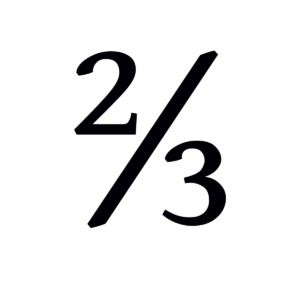 |
This is the _____________.
It represents: |
Draw the fraction here. |
|
This is the _____________.
It represents: |
Assessment/Differentiation

Use the checklist to record students’ knowledge that:
- The numerator is the top number and the denominator is the bottom number of a fraction (K1.)
Q1e. In a fraction, what do the denominator and numerator represent? (C)
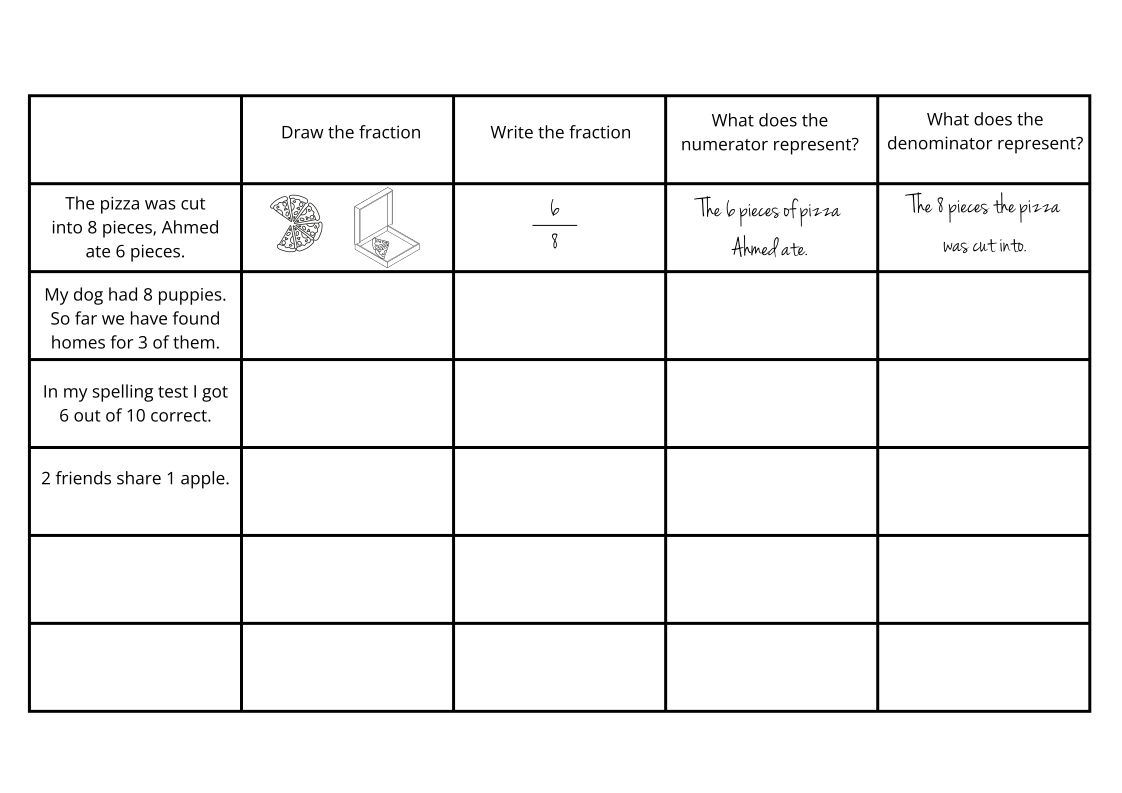
Use your knowledge about numerators and denominators to complete the comparison chart below
Read each statement in the left-hand column.
What fraction is involved? Can you draw it?
What does the numerator in these statements represent?
What does the denominator in these statements represent?
Add some of your own examples in the bottom rows.
Assessment/Differentiation
Support: Students who experience difficulty with the last two columns of the chart will need support, either individually or in a small group, before they are ready to generalize U1. Use manipulatives to illustrate.
Assessment/Differentiation
Formative assessment
The first and fourth rows should give evidence of students’ ability to:
- Solve problem situations involving fractions of a shape, and record the process and result using fraction notation. (S4.)
Use the checklist to record student responses. (print double sided)
Generalize U1
Conceptual question: In a fraction, what do the denominator and numerator represent? (Q1e.)
I understand that…
Conceptual Understanding (Students articulate in their own words)
In a fraction, the denominator represents the equal number of parts in the whole and the numerator represents the number of those parts involved in the problem. Note: Students could write this as two separate generalizations if they find one easier to address than the other.Assessment/Differentiation
Summative assessment
Do students’ responses show an understanding of U1? Record this on the Partitioning Ph5 Understandings checklist.
Which students do you need to conference with to clarify their generalizations?
It can be tricky to remember the difference between two related words! Imagine you have a friend who has a hard time remembering which number is the denominator and which number is the numerator. As a group, develop a way to help your friend remember.
Assessment/Differentiation
Summative assessment
Do students’ responses confirm an understanding of U1? Which students do you need to conference with to clarify their generalizations?
U2
Conceptual understanding: 2
The greater the number of equal parts, the smaller each part becomes.
Associated Knowledge & Skill
S2. Compare and order unit fractions. S4. Solve problem situations involving fractions of a shape and record the process and result using fraction notation.Guiding Questions
Q2a. What can we call these fractions? (F) Q2b. What pattern do you notice as the number of equal parts increases? (F) Q2c. What is the relationship between the number of equal parts and their size (C)Supporting Resources
Sample Only
Click here to register.

